



Phone:
+86-15978414719
Publish Time: 2026-09-29 Origin:https://www.hmaluminumsupply.com
5 Bar Aluminium Checker Plate is a rolled aluminium tread product with five raised bars repeated across the surface. It is widely specified for vehicle steps, access platforms, walkways, trailer decks, machine guards, wall protection, and temporary flooring.
For industrial applications, the main concern is often wet-slip performance. A raised five-bar pattern can improve footing compared with a smooth surface, but pattern appearance alone does not prove compliance with a slip-resistance requirement. Tread height, bar spacing, alloy temper, surface contamination, installation direction, drainage, footwear, and wear all affect in-service traction.
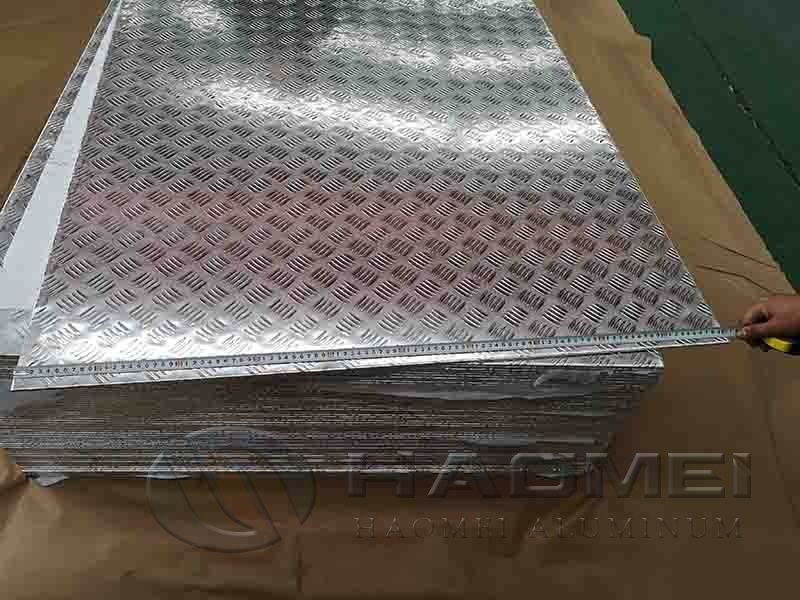
For United States supply, ASTM B632 covers aluminium-alloy rolled tread plate. It addresses material, dimensions, tolerances, workmanship, inspection, and testing requirements for rolled tread products. For European projects, EN 1386 applies to aluminium and aluminium-alloy checkered plates. Contract documents should state the applicable standard and revision, rather than using the term "checker plate" alone.
Common alloy-tempers are shown below. Availability by thickness and mill capability should be confirmed before placing an order.
| Alloy and temper | Practical characteristics | Typical applications | Selection notes |
|---|---|---|---|
| 1050-H14 | High aluminium content, good formability and corrosion resistance, relatively low strength | Decorative panels, light-duty protection | Use where structural loading is limited |
| 3003-H22/H24 | Improved strength over 1050, good forming response and atmospheric corrosion resistance | General flooring, toolboxes, interior vehicle panels | Common economic choice for dry or moderately corrosive service |
| 5052-H32 | Higher strength and strong resistance to marine and industrial atmospheres | Vehicle steps, docks, marine access areas, outdoor platforms | Preferred where corrosion and repeated loading are more demanding |
Do not substitute a smooth aluminium plate and add a pattern description in paperwork. Rolled tread plate has a distinct raised surface formed during rolling, and its ordered thickness may be stated as base metal thickness or overall thickness. This distinction affects fit-up, load calculations, welding gaps, and weight estimates.
A purchase specification should state:
Applicable standard: ASTM B632 or EN 1386.
Alloy and temper.
Base thickness and permitted tolerance.
Overall thickness, if the project controls finished height.
Width, length, edge condition, and allowable diagonal or flatness limits.
Five-bar pattern orientation relative to walking direction or drainage slope.
Mill test certificate requirements and traceability by bundle or plate.
Surface condition: mill finish, protective film, anodised finish, painted finish, or other approved treatment.
Five-bar tread improves surface texture, but it is not automatically certified as anti-slip. Oils, mud, ice, detergent residue, wear polishing, and trapped water can substantially reduce friction. A procurement document that says "non-slip aluminium" without a test method, test condition, or acceptance criterion cannot be objectively verified.
Use this process when wet traction is safety-critical.
Define the service condition. Identify footwear, expected contaminants, cleaning chemicals, water exposure, incline, traffic frequency, and whether the area is indoors or outdoors.
Set the installation orientation. Raised bars should be positioned to support expected foot movement and drainage. For ramps, review orientation with the designer because cross-bars can retain contaminants in some conditions.
Require representative test evidence. ASTM E303 describes use of the British Pendulum Tester to measure surface frictional properties. State the test slider, wetting liquid, test direction, temperature, conditioning, and required result in the project specification.
Test the finished system where risk is high. A factory sample does not represent a floor after cutting, fastener installation, sealant application, coating, field contamination, or months of abrasion.
Establish maintenance controls. Include cleaning frequency, approved degreasers, inspection intervals, and replacement criteria for worn or damaged panels.
| Situation | Suitable approach | Avoid |
|---|---|---|
| Dry internal walkway | 3003 tread material with controlled thickness and normal cleaning | Assuming raised bars provide the same grip after oil contamination |
| Outdoor platform exposed to rain | 5052 material, drainage detail, wet-condition friction evidence | Installing panels with water-trapping joints or blocked drainage paths |
| Food, chemical, or washdown area | Corrosion-compatible alloy and documented cleaning validation | Selecting by alloy only without checking chemical compatibility |
| Ramp or angled access | Project-specific friction target and installed-surface test | Using a horizontal-floor test result as proof for an incline |
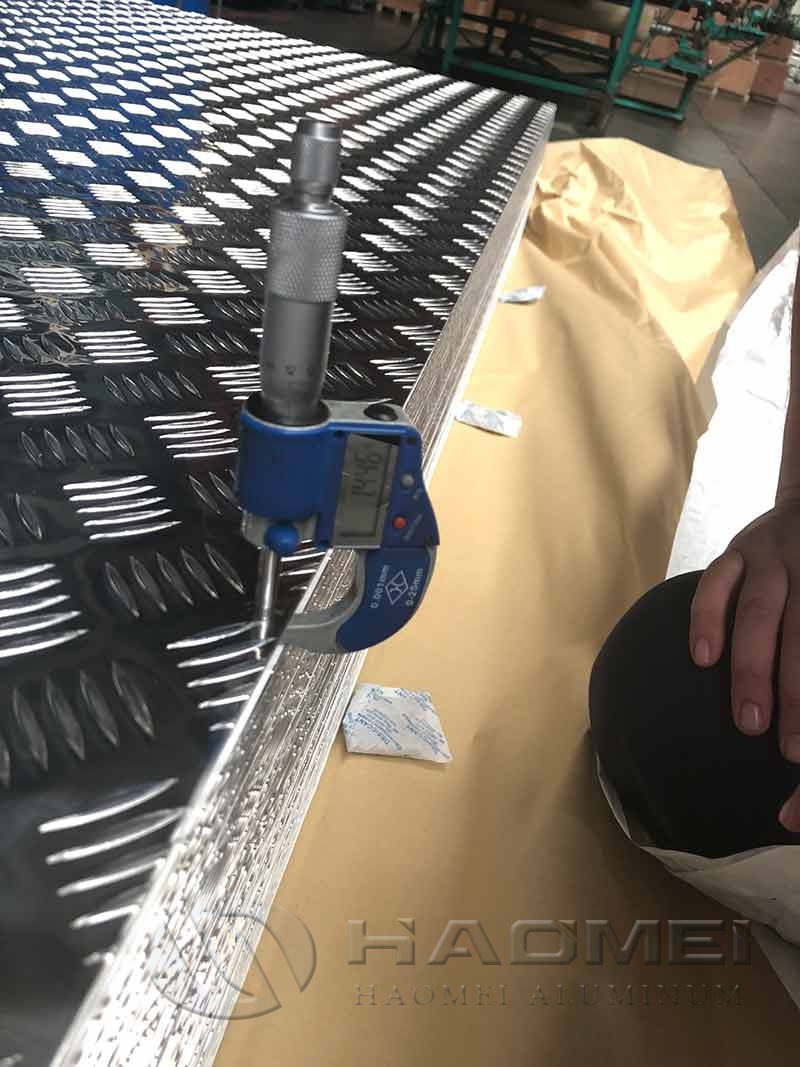
Incoming inspection should begin before fabrication. Examine bundle labels against the certificate, then measure at several positions away from edges and raised-bar peaks. Confirm whether the measured value is base thickness or total height. Inspect for dented bars, oil staining, corrosion marks, roller damage, excessive waviness, and protective-film adhesion issues.
For mechanical verification, request the mill certificate showing chemical composition and temper-related mechanical properties required by the selected standard. Do not treat a generic certificate as proof for a specific delivered bundle unless heat, lot, or traceability identifiers match the material marking.
Material cost is mainly affected by alloy, metal market basis, conversion charge, thickness, width, cutting yield, protective film, surface treatment, and freight. The five-bar pattern itself is not a reliable indicator of alloy quality or load capacity. A lower initial price can create higher fabrication waste when width, length, flatness, or thickness basis has not been fixed.
Use this receiving checklist in the purchase order and inspection record:
| Acceptance item | Required evidence or check |
|---|---|
| Material identity | Bundle label matches order, certificate, alloy, temper, and traceability reference |
| Standard compliance | Certificate explicitly identifies ASTM B632, EN 1386, or the stated contractual standard |
| Dimensions | Calibrated measurements for width, length, base thickness, and overall thickness where required |
| Pattern condition | Consistent raised bars without crushing, major dents, or unacceptable rolling defects |
| Surface finish | Agreed finish, film condition, staining limits, and corrosion-free appearance |
| Slip-related requirement | Test report with declared method, surface condition, direction, and acceptance criterion |
| Packaging | Edge protection, moisture control, pallet stability, and identification retained through fabrication |
For wet or contaminated pedestrian areas, include installed-condition friction verification in the project inspection plan. This converts a visual tread selection into a measurable safety requirement.
With the development of dozens of years, we, Haomei Aluminum has solid base to provide clean aluminum material for the high-end applications including lithium-ion battery, lightweight automobile body, 3c products, aluminum brazing and other special uses.